
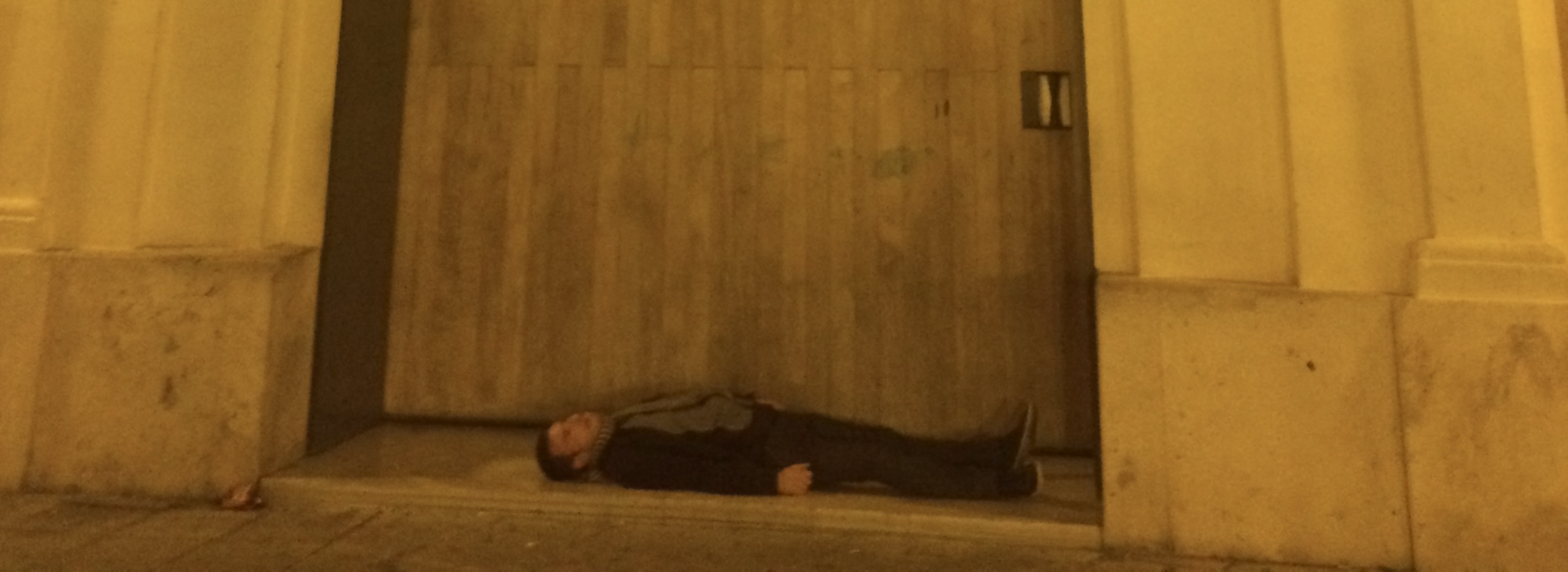
Collapse
I never sought Eudaimonia.
On the 23rd of March, 2019, sitting in the kitchen with a pounding headache caused by alcohol withdrawal, stress and antidepressants, I knew everything was about to change.
I was done. Having quit my job a few weeks before and seen the doctor about my anxiety, change was already underway, but I had still been knocking back the wine – probably harder than ever before. That morning, however, I knew I was done.
This wasn’t determination; it was discovery. I found myself in a new scenario; I’d finally had enough to drink.
There was just this sense that, whatever I had been telling myself about alcohol – whatever beliefs I was carrying around with me – were utter bullshit. I was a wreck, and there was simply no good reason to continue being a wreck. But why the change of heart?
I think it was that, finally, reason overpowered comforting beliefs. If you believe something erroneous, you can go on doing so for a very long time. Reality doesn’t immediately object. But, in the background, it continues meting out consequences to everything, including one’s own actions.
One of the curses of life as a rational agent is that we are often clever enough to postpone those consequences. We can explain them away, compensate for them, or arrange our lives so they don’t quite catch up with us. Sometimes that works for years. Sometimes it works for a lifetime.
But nothing is actually avoided. Reality keeps its own accounts. The bill is simply deferred, and like any debt, it gathers interest. Lies require further lies to sustain them, and contradictions demand ever more effort to hold together. Eventually, someone pays. If not today, then tomorrow. If not you, then someone else.
And I think the contradictions had simply become impossible to ignore. Fundamentally, this hedonist’s approach to pleasure-seeking only really seemed to bring pain, for me and everyone I loved.
There were other contradictions in me too: a desire to “win at life” somehow, while doing everything to ensure that couldn’t happen; a love of logic, reason and thought while barely ever being up to the task of pursuing them; a sense that life was boring without alcohol while doing very little other than drinking.
So, on that day, the shattering of my drinking self suddenly brought these contradictions into plain view. And so they shattered alongside it.
It became very clear to me that I had been carrying around an awful lot of bullshit. And, instead of trying to work out who I really was – certainly not consciously, anyway – I just kind of went back to first principles. I assumed everything was false, unless I could see a good reason for it.
One way to describe this transformation is a reprioritisation: I was no longer going to chase good feelings but, instead, live by reason. Chasing good feelings clearly hadn’t worked, even on its own terms, as I was feeling like shit most of the time. So I basically abandoned that whole approach.
And I started to wonder why feeling good had ever really been the goal; if somebody could give me a drug that made me happy forever, while just sitting in a chair all day, would I take it? The answer was “no”. And so I began to understand that, while we often think happiness is the end goal, something in our nature cries out for more than that. We don’t just want to feel good; we want something that we know is good too.
I had no idea what that might mean. How can we know something is good? Is anything objectively good anyway?
That question lay dormant within me for many years. It was a bit too abstract to address at the time. Instead, I just wanted to rebuild my life. I was feeling practical, not philosophical.
I just wanted everything to be better.
Having jettisoned an awful lot of baggage, I started to feel much lighter. What I had now was clarity. I might not know what is objectively good, but I was pretty sure of what my needs were: to build a business and create some enduring stability in my life.
That clarity did not answer every question, but it altered the structure of every answer that followed.
Reason & Feeling
Now, before I talk much more about emotions, I want to make one thing super clear: emotions are a hugely important part of the human experience. They’re there; they’re real. The only difference now was that I was no longer going to defer to them. I would feel them just as much as before, of course, but they wouldn’t be in charge.
I understood that emotions had evolved to help us survive in a world we no longer inhabited. I knew that the cerebral cortex was responsible for building this new world, and was therefore required to help us navigate it. Pilots use instruments as well as gut feeling; both are valuable. But the pilot decides when to use which.
So there was never any question of locking up my emotions or pretending they weren’t real. I was just going to use them as information, rather than direct orders.
The goal was to make everything actually better, rather than feel better.
And now we approach a tension that took me a long time to resolve: how do we know what’s better without referring to feelings? Isn’t “better” just subjective anyway? And, thinking about this for many months, I realised that, while preferences are subjective, the ones we hold really are the ones we hold! Our preferences – our values, if you prefer – are those things that, when fulfilled, leave us at peace, at equilibrium. I think of this more as a psychological state than an emotion.
If we rely on feelings alone, we can get this wrong. That’s not controversial; I was getting it wrong every time I drank. I really, genuinely wanted to drink, but it never actually fulfilled anything.
Urges are calls to action, and the action may not be right for us – it may not bring equilibrium. So it takes more than urges to get this right. We have to understand what’s triggering those urges. And it’s important to remember that, while urges evolved for their survival value, they can easily misfire in the modern world. Sure, thousands of years ago, when calories were scarce, getting more food was always good. That’s not the case now.
We used the cerebral cortex to build this world; we will always have to use the cerebral cortex to navigate it. We can listen to our feelings, but we have to understand them intellectually.
And, thinking about all this led me to a concept I came to call “boredom & beauty”.
Boredom & Beauty
I’d always hated being bored, and I guess, deep within me, I’d always carried a belief that boredom was failure – that boredom could, and should, always be avoided. That started to feel faintly ridiculous, and I was surprised to discover I’d been living under that assumption.
Boredom is simply a craving for novelty, and there’s only so much novelty a well-functioning human can have. We get better at things by practising, we get more efficient through repetition and planning and our whole economic system is built around specialisation. And then there’s maintaining what we’ve already built; that requires cleaning and tidying, whether that’s a room or a file structure. And is boredom that bad anyway? I came to see it as a sign that everything is fine.
And so I started doing lots of boring things with gusto. Ellie and I worked out all our chores and divided them between us, using a shared to-do list on our phones.
I then spent weeks building a spreadsheet that works out how many “days of financial freedom” we have at any one time; it knows what we spend on average, and what our recurring costs are, and tells us how long we can go on spending at the current level without earning any more money.
It’s ridiculous, and I love it.
And it didn’t end there. I started having the same lunch every single day (chicken with cheese in half a baguette, in case you’re wondering). I bought a load of cheap, simple black t-shirts so I didn’t have to think about what I was wearing; I was already wearing Levi 501s every day, so the t-shirts just completed the ensemble.
Along with Ellie, I created the most boring household in existence. So where does the beauty come in?
Well, I’d always been interested in the concept of beauty – more from an intellectual perspective than an aesthetic one, but aesthetics certainly come into it. More specifically, I was concerned with the idea of beauty as a sort of combination of regularity and difference.
That sounds really abstract so I’ll give you a couple of examples:
Music: Music generally works with a relatively fixed rhythm and group of pitches (the key). This framework then plays host to a sequence of variations in pattern, with rhythms and melodies intertwining in a way that is often original but rarely shocking. There is a structure, without which the harmonies and beats would be meaningless.
Images: We often respond well to images that are “balanced” but asymmetrical. Symmetry is just repetition, whereas balance is complementary.
Regularity and difference. Multiple elements working together as a whole. I started to think about these ideas deeply.
And while thinking, I came to understand that beauty brings a kind of deep satisfaction that modern life finds difficult to sell to us. I started exploring the things I find beautiful. They’re not often things that strike you that powerfully when you imagine them. Have you noticed that?
One example: hiking. I’ve been into hiking most of my life and yet, whenever I think about it, I feel kind of uninspired, a bit meh. It’s walking. Walking with a nice view for a long time.
Do you know why nobody gets to charge you for hiking? It’s not because there are rights of way; they could be lobbied out of existence in the time it takes you to lace up your boots. No, walking is free because nobody would pay to do it.
And yet…
I don’t know why, but whenever I go hiking, I feel a deep connection with my surroundings. Maybe it’s the rhythm? Maybe it’s moving along at a human speed? I don’t know what it is, exactly, but whenever I’m walking, my mind feels alive. My thoughts are structured, clear, interesting and, if I do say so myself, often very funny. Conversation is amazing while walking; it ebbs and flows at a natural pace.
And people disappear while walking. I’ve noticed this in myself and, I believe, in others; the self disappears. People stop wallowing in their heads and start to live in the world. They become part of the surroundings and willingly embrace that position. Nobody has an ego when walking.
Walking is beautiful. Ellie and I decided to start walking more and, specifically, to start walking more in our locality, rather than always drive off to far-flung beauty spots. There’s something about that visceral connection with where you live, something that is deeply beautiful, even if where you live is not.
I also really got into collecting playing cards, and slowly learning card magic. I’d always found cards to be fascinating in some way, and I loved the idea that almost anyone could learn to do a practically limitless number of things with them.
And cards are entirely free of bullshit. Almost no marketing, very little attention on social media, no validation, no status markers and no pretense. Playing cards have been around for hundreds of years (possibly thousands, depending on how you define them) and now you can buy them for a couple of quid in a petrol station.
Even better, playing cards do almost nothing, until you learn. They’re a canvas on which skill, creativity and focused practice paint a picture – a picture that honours a great tradition while also being uniquely yours. Playing cards, and the skills we build around them, are the perfect antidote to the modern world, with its status anxiety, noise and tribalism. None of that counts for anything when you’re practising.
Talking of which, my hand-eye coordination is naturally pretty poor. This means I learn card skills, I suspect, more slowly than other people. But that doesn’t matter; I learn every day, without fail.
I have other interests as well, such as video games, music, fitness, writing and thinking. These all contribute to a life that I find beautiful. Fixed patterns through which the losses and gains of life flow.
So how do I experience that, day to day?
Music
I suppose the most noticeable characteristic of this life is a sense of rhythm. There’s a flow to my day from the moment I get up. As I implied earlier, when mentioning my lunch and our to-do list, I live by routines. These form the backbeat of my day. And while there are a lot of similarities to each day, there are also ever-changing melodies and harmonies: The conversations, the laughter, the writing, the learning and the weight training.
It feels like all of these things fit together; both within the day, and within my overall goals. It feels coherent.
I’ve also developed a confidence that I’ve never really had before. It’s not flashy or showy; it’s self-assuredness, not arrogance. And, rather than this being a shift in personality, as such, it’s more like a response to the circumstances. It comes from knowing that I’ve done my best.
Because, if the big things have been decided through a process of carefully reasoned thought, you can usually remember why you decided to do them. It’s never “Well, I just felt like it”, and this means you can see where you went wrong when making the decision. I guess that’s what they mean when they talk about personal accountability. You can account for your decisions, so if they went wrong, you can course correct.
Somehow, that really takes the ego out of it. It takes the sting out of failure, knowing what went wrong and why, and how you made that decision. That makes sense, actually, because rather than “I couldn’t help it”, you can see that you made a decision with incomplete information.
That’s when decisions go wrong: When we have incomplete or inaccurate information. That’s not something to be ashamed of; it just means we’ve got something to learn.
And if we let our emotions take control, especially when we know how easily they are influenced by externalities, the lessons are just a little deeper.
If this all sounds a little clinical, I should also mention that my life is so much more fun than it used to be. When you feel self-assured, you can be a lot more playful; you can afford it. And, when I’m not making decisions, writing, doing my chores or pursuing my hobbies, I’m often just being very daft. I don’t know why, really; I just love making up stupid songs, dances and voices. You’ve probably seen some of my silly posts on LinkedIn. There’s no strategy there; it’s just, I don’t know… fun. It’s play.
I guess you might say I don’t take myself very seriously. But I do take what I do very seriously. What I do is up to me; who I am is a result of many, many factors, most beyond my control. And what I am is for others to decide, if they must.
Naming It
Now – we’ve got this far, and I don’t think I’ve mentioned Stoicism once. There’s a reason for that: for much of this transformational phase, I barely knew what Stoicism was. I haven’t read Ryan Holliday or any of the other recent popularisers of this philosophy.
I started this process with the great fortune of being forced to almost start afresh with my life. Working from first principles, and the lessons my addiction taught me, I was able to build my life deliberately, rather than merely be inducted into customs and expectations, as necessarily happens with children.
But I did discover Stoicism along the way, and I was surprised by how well it aligned with everything I was thinking and doing. Some of the philosophy clicked straight away; other bits took time. It took me a long time to figure out how it all fit together into one, meaningful whole.
Having done that, I now see that this integrated view of life – this coherence, in which all the parts function as a whole, and the whole functions as part of the greater fabric of reality – is known as Eudaimonia.
Everyone is different, and so everyone’s Eudaimonia may look different. As long as it includes living virtuously, in harmony with the self and the world, then it’s Eudaimonia.
Enjoy discovering yours.
Next essay: The Foundations Series: Part 2 – Why Reality Matters
The Foundations Series main page
If you’re interested in the philosophical framework that eventually grew from these reflections, you can read my Stoicism Explainer here.