
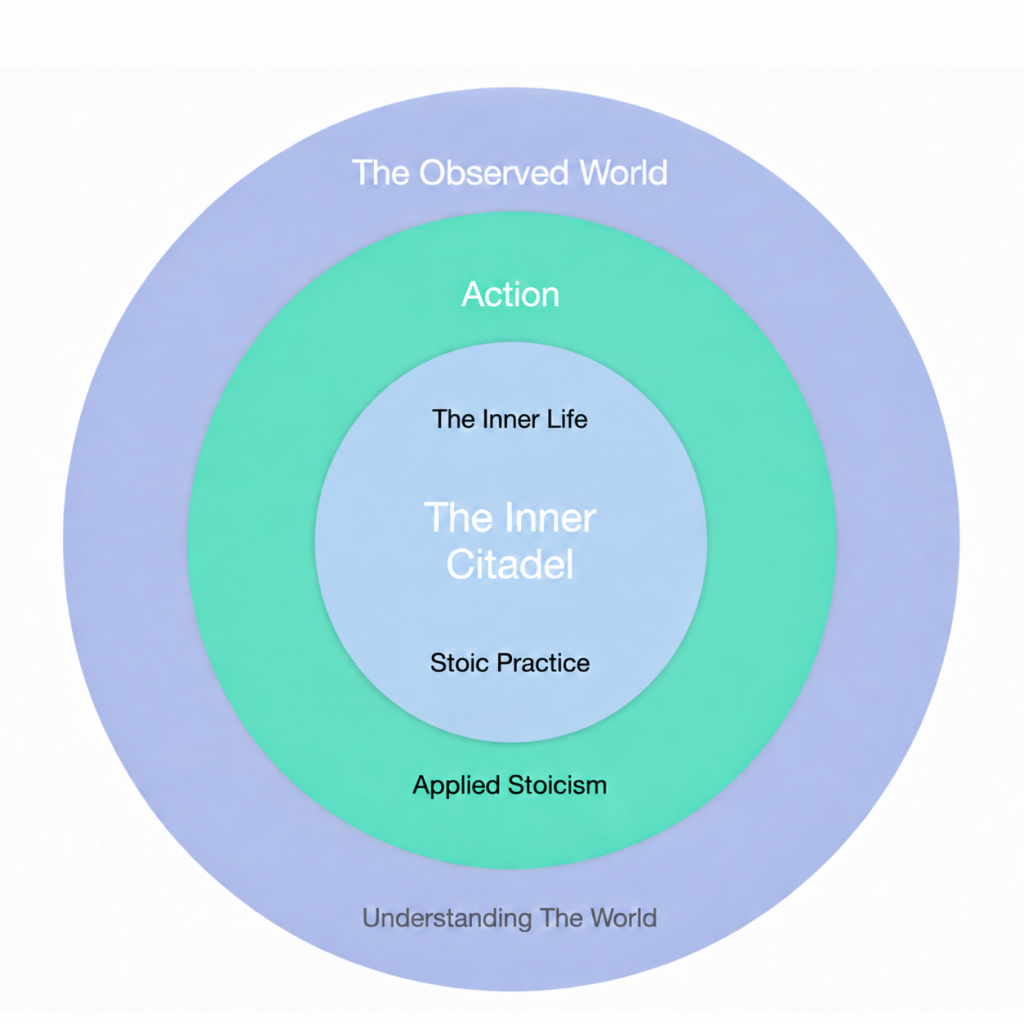
From the Inner Citadel into the World
Now is the time for action.
In Part 4, we visited the Inner Citadel, the very heart of rational agency. We discussed inputs – particularly how they become judgements, how those judgements affect us and how they shape the decisions we see before us.
But, at some point, decisions must become actions, and that means interacting with the world. So let’s head out into the Domain of Action, where we will do something.
Why are we venturing out? To try and secure certain outcomes, of course. But it’s going to get messy, as our rational agency butts heads with physical constraints, uncertainty, pure chance and a whole load of other rational agents pursuing their own goals.
Anything can happen out there.
If the Inner Citadel was ours to govern, then the Domain of Action is a no-man’s land. Nothing is certain here; no outcomes are guaranteed, no matter what we do.
But that doesn’t mean we’re not prepared. We bring with us the Discipline of Desire, which will enable the spirited pursuit of outcomes without attachment. Don’t worry: that’s more straightforward than it sounds, as we shall see.
We also carry the Discipline of Action. This crucial tool will help us navigate the human world of rational agents without tearing the social fabric apart. Are you ready?
Into the wild!
Objectively Speaking
Before we make any decisions – before we even think about taking any action – we need an objective.
This is no problem, as we humans pretty much always have a goal. In fact, an inherent characteristic of people is that we are goal-orientated rational agents.
Before we start pursuing an objective, we really ought to reflect on it. Why am I trying to achieve this? Where does this goal come from? Is it an instinctive urge? A desire? A prerequisite for some other objective?
But we don’t need to ask these questions right now. We’re going to assume you have a goal because, if you didn’t, there’d be no need to consult a practical philosophy at all.
Imagine it. It would be perfectly rational to do nothing – to just sit there in your own waste until you died. Nothing would matter at all. Rational agency would be meaningless, because all available choices would be of equal value. In which case, roll a die!
But that’s not the case, is it? As soon as we have an objective, a prize to win, a desired outcome of some sort or another, rational agency starts to become meaningful: it’s the only tool we have to influence the future and make those objectives more likely. Some decisions will be better than others, and we can make that judgement using the information available to us.
I love illustrating this through one of my passions: games. Games are great because they provide you with a simple, ready-made objective. There’s challenge, jeopardy and a chance of glory, all without anybody dying.
And, right now, you find me playing Carcassonne with Ellie.
I’m playing pretty well, as it happens. If I draw the one remaining tile with a bit of city to the left and a section of road curving up to the right, I’m laughing! And, given there are only two of us playing, there’s something like a fifty percent chance that tile is mine. And, of course, 50% is 0.5. My maths from school reminds me that we always round 0.5 up to 1, so victory is a foregone conclusion.
I sit back and reflect on my brilliance.
But then Ellie draws that tile! WHAT??? Maths is wrong!
And from that point, she nickels and dimes a few more points here and there, while I try more risky moves to get back in the game.
It doesn’t work. Ellie wins. And, dear reader, that hurts. It really hurts because I was playing so well!
Luckily, it’s only a game, and the loss doesn’t really matter. And, more pertinently, the objective of winning gives us a context in which our decisions can be evaluated. Looking back, I think some of my decisions might not have been as sound as I thought in the heat of the moment.
But, like I say, it’s only a game. A stupid, pointless game.
Besides, I have an essay to finish. Let’s move on to the next section.
Needs Must
Like I say, games are fun; you get to play in an isolated world in which you’re challenged, imagine strategies and tussle with opponents. They provide an arena in which you can excel or not – without any of it really mattering very much.
If only the rest of life were like that.
Unfortunately, I do need to earn money. And that is a need because, if I don’t, things will happen that I don’t want to happen. Maybe I’ll go hungry; maybe I’ll become homeless.
That’s what a need is: a prerequisite for securing or protecting something we care about.
But the need doesn’t do any work towards the outcome. You can shout ‘BUT I REALLY NEED THIS!’ And the universe will just shrug, because that’s not how cause-and-effect works. Maybe someone else will help out, but that’s their decision to make and it’s out of our hands.
When the stakes are high, of course, we may devote more attention, effort and resources to our goal, but we still have to accept that, even if we do everything right, our actions will only ever amount to contributions to that outcome.
So what do we do with that? What do we do when we can try our best and still fail? What do we do when we see others enjoying amazing luck that they clearly didn’t deserve? What do we do when the decisions we make and the actions we take are necessary to secure an outcome, but never quite sufficient?
The answer is that we learn to accept that deal, because there is no better one on the table. We govern our decisions, our words, our actions – but we can only add them to the mix of causal factors and see what comes out the other side.
This seems to be one of the hardest ideas for people to accept. How can I simply not be attached to something I need? Even worse: how can I not be attached to something – or someone – I already have in my life? What can it mean to not be attached to those things?
The Discipline of Desire
OK then, let’s go deep. What did the Stoics mean by attachment?
Well, when we’re talking about our desires (or needs) and our plans, we’re using our rational agency. We might not be using it well, but we are using it.
‘I want a new watch. What can I do to try and make that happen?’
I can check my bank balance, think about my financial commitments, read reviews of various watches, decide what I’m willing to sacrifice amongst my other desires and generally just have a good think about it.
This is my rational agency at work; it is surveying the landscape and making decisions. My rational agency is doing work.
And then I’ll go and buy a watch. The instant I do so will be an important moment; it will be the exact point at which a possibility becomes an incontrovertible fact.
Once that happens, I will never be able to have not bought that watch. In terms of changing that exact decision, there is absolutely nothing more my rational agency can do. Sure, I can learn from it, and maybe I’ll decide that buying the watch was a mistake.
And I could regret my stupidity, perhaps my impulsiveness or poor judgement.
Maybe I’ll feel embarrassed for making a mistake. Maybe I’ll castigate myself for doing such stupid things. Maybe I’ll feel sorry for myself and angry at the marketing that made me buy the damn watch. And, if I do all this, I will be expending emotional energy and cognitive bandwidth, but this activity won’t, in itself, be doing any work towards an outcome.
Maybe, once I’ve got over my little moment of regret, I’ll realise that I still have time to return the watch and get a refund. I’ll mull that decision over and my rational agency will, once again, be back in the office.
And this is what the Discipline of Desire cares about. It cares about using rational agency for work, and not wasting it on fruitless mental and emotional effort. It cares about desiring what is still possible, and using our decisions and actions to contribute towards making those possibilities real.
Ultimately, it’s about resource management. When you got up this morning, you had a certain number of hours before bedtime; you brought into the day a finite capacity for thought, attention and decision-making. The Discipline of Desire is about not wasting that capacity fighting battles that aren’t yours to win.
Don’t waste your power to change things by ruminating on the things you can’t; that’s the message of the Discipline of Desire.
Let’s be very specific now, lest we get confused. The Discipline of Desire is concerned with those internal moments when we fight the truth, but it doesn’t prohibit reflection. We can think about the past, perhaps because it’s pleasant, or there’s something to learn. We can think about all sorts of things that are outside our power to change. Why not?
But there is a discipline in refusing to try and change what we cannot, through bargaining, wishful thinking, or cyclical and fruitless rumination. And, yes, that is the Discipline of Desire.
It’s not just about now, that pivotal moment when possible becomes fixed; it’s just that this specific point in time helps us think clearly about the dividing line between the two. There are many other fixed things, far out of the reach of our rational agency.
I know this may all seem rather obvious. We have familiar expressions which succinctly cover this exact idea: ‘What’s done is done’, ‘You can’t change the past’, and even ‘Well, that’s that’.
Knowing these expressions is one thing; living by them, however, is not so simple.
And that’s easy with something like buying a watch. But the bigger the possibility, the more difficult it gets to live this way. We can spend days, months, even years trying to mentally renegotiate settled reality: reliving our most embarrassing moments, repeating long-dead arguments, trying to conjure back some golden past.
Or we can use our rational agency to make things better tomorrow, whatever that means to us.
And we already know we’re capable of this, because we do it all the time. Remember that game of Carcassonne?
I wanted to win. I really wanted to win. I thought about the tiles I needed, tried to predict what would happen, changed my strategy and took increasingly desperate risks when things started to go wrong.
That wasn’t attachment, but engagement. My objective was still possible, and pursuing it was rational, even if my approach was not.
And then Ellie won.
At that exact moment, the outcome of that particular game went from possible to fixed, and there was nothing more I could do to win it. I could reflect on how I’d played, of course. Maybe there was something useful to learn for next time. But I couldn’t change the result. So I stopped trying.
There was now no way to engage with the game, and any continued attempts would become attachment.
Besides, I had an essay to finish.
I love how well games teach us this lesson: we can care about an outcome, pursue it vigorously, even desperately want it, and then let it go when it becomes fixed. Games make that relatively easy because, as we’ve already established, they don’t really matter very much. Unlike the rest of life, of course.
If I lose my job, the result doesn’t just disappear into irrelevance like a lost game of Carcassonne. I might need that income. My home might depend on it. Other people might depend on me.
But none of those consequences can change what’s happened.
In fact, those consequences give my rational agency more work to do, not less. What can I learn? What do I do next? How do I protect the things I care about? What possibilities remain?
Need increases the importance of the outcome. It does not increase my agency over an outcome that has already become fixed.
And that, I think, is the trick. The Discipline of Desire doesn’t ask us to stop caring about outcomes. It doesn’t ask us to pursue them half-heartedly, or pretend that losing something important doesn’t matter.
It asks us to care while there is still something our rational agency can do. And when there isn’t, to let go.
That point where we don’t manage to let go? Well, that’s what I understand by ‘attachment’.
Got it? Great! Now you won’t get attached to things!
Of course you will; this takes a lot of practice, as the Stoics well knew. Fortunately, they came up with ways to practise it. And one of the best is premeditatio malorum.
The idea is to rehearse that moment when possible becomes fixed. This is, of course, easier with the more trivial matters in life. Perhaps somebody will criticise you tomorrow. Ouch!
So imagine what you’ll do if that comes to pass. See yourself in that situation, picking up the pieces and continuing to exercise your rational agency. What will you feel? What stories will your brain tell in that moment?
Is your critic lying? Are they trying to hurt you? Even worse, are they right? Well, however you experience it, you’ll still be there, making decisions.
There may not be life after death, but there is usually rational agency after adversity. And your decisions can help you make things better, wherever you find yourself.
After practising with the less devastating scenarios in life, you can gradually increase the seriousness. It takes time.
I personally know people who find the practice of premeditatio malorum extremely difficult. But hard as it may be, it’s a great way to train for the worst – to rehearse that moment of experiencing agony, as well as continued rational agency. Assuming this thing doesn’t kill you, you’ll still be there with decisions in front of you, and there will still be an opportunity to decide well and flourish.
Because, let’s face it, you’ll need your rational agency to be at its best.
Naturally, the Discipline of Desire is easier to learn with the small things in life – much harder with the big ones.
But that’s how it is! And it’s almost the exact reverse for the Discipline of Action.
The Discipline of Action
The Discipline of Action mainly concerns the Cardinal Virtue of Justice.
And lesson one of the Discipline of Action is: Don’t murder anyone.
Have you ever murdered anyone? I’m pretty sure that, for most readers of these essays, the answer is ‘no’. And that’s good. I like it when people don’t get murdered.
So yes, for the individual rational agent reading this essay, the big things are already pretty much taken care of. We live in a reasonably civilised society, with laws, courts and prisons. Over millennia, humanity has gradually built up a whole raft of institutions that try to ensure society isn’t a totally lawless hellhole.
But, for the dedicated Stoic, that doesn’t mean the problem is entirely solved. The Discipline of Action still has plenty to say about how we exercise our rational agency around others. In fact, this is where things get interesting because, unlike the Discipline of Desire, the smaller things can be much harder to spot.
At some point, somebody’s going to lie to you and, when they do, you may make a perfectly rational decision based on a falsehood. When that falsehood reveals itself, you’ll feel the rug of reality pulled from under your feet as you crash to the floor.
You do have a rug of reality, don’t you?
Well, anyway, when that happens, the deceiver will have stolen from your rational agency and twisted reality to their own ends.
We can observe similar assaults on rational agency in other moral case studies too. Looking through this lens, theft is wrong because it denies somebody a resource to which they had a reasonable expectation of exclusive access. You’ve changed reality so that the victim’s reasonable expectations were wrong.
And that’s the funny thing about rational agency in a social species: while it exists within each Inner Citadel, its effective exercise also depends on a vast web of relationships that connects us all.
In the Discipline of Desire, we looked at all those things that contribute towards our outcomes. Physical reality, chance, other people and their decisions all become part of the environment in which we exercise our rational agency.
But, of course, this works both ways.
We are part of that environment too.
Our decisions become part of the reality in which everybody else has to exercise their rational agency too. And, just as we would prefer reality to be legible, predictable and stable for us, our actions can make it more or less legible, predictable and stable for everyone else.
Murdering someone is a fairly obvious failure on that front.
But what about telling somebody you’ll do something and letting them down? Perhaps you fully intended to keep your word when you gave it. But then something changed, you decided not to bother and you never told them.
Meanwhile, they carried on making decisions based on the reasonable expectation that you were going to do what you said.
You didn’t murder them. You didn’t steal from them. You didn’t even necessarily lie to them.
But you made their reality less navigable.
And we do little things like this all the time. We allow people to continue operating on information we know is out of date. We make commitments casually. We imply things that aren’t quite true because correcting the misunderstanding would be inconvenient. We change our plans without considering the plans other people have built around them.
None of these things will get us thrown in prison. They may not even feel particularly unjust.
But they matter because other people are rational agents too. They’re observing reality, forming judgements and making decisions, just as we are. And our actions form part of the reality they’re trying to understand.
In a world of many rational agents, whose actions are unpredictable to each other, we have constructed agreements and legal systems designed to reduce some of that unpredictability, increasing the clarity with which each rational agent can make decisions.
As I wrote in Part 3, justice works towards making the social realm of humans legible, predictable and stable, as well as free from certain harms.
But why should you care? Are you logically required to do so in order to preserve your own rational agency?
The answer is no.
It could be perfectly rational for you, as an individual, to consider the obligations of justice too much of a constraint in the pursuit of your goals. That could be correct; you may find that lying, cheating and stealing make it more likely you’ll succeed.
Most people, of course, consider lying, cheating and theft immoral. We tend to care about others, at least to some extent. We can see why these things hurt them and why that matters, even if we don’t think about it in terms of rational agency as such. Failing that, we’re wary of punishment and social exclusion.
But once justice matters to us, for whatever reason, the Discipline of Action asks us to take seriously the consequences our actions have for other humans, who are rational agents too.
That doesn’t mean making their lives perfectly predictable. It doesn’t mean subordinating your objectives to theirs, or trying to protect everybody from every unpleasant surprise. Other people have their objectives and you have yours. Sometimes those objectives will conflict.
Justice means recognising that you are part of the reality in which their rational agency has to operate too. More philosophically, the Discipline of Action considers all rational agency equally, whether it’s mine, yours or his. There need be no egalitarian, peace-and-love reason for this; it’s that there’s nothing inherent in rational agency that makes one instance of it more important than another. In other words, why would your freedom to make decisions ever be subservient to mine? Can’t think of a reason? Neither can Stoicism.
So, that’s that. And while you might never murder anybody, there are countless little ways to make that reality less legible, less predictable and less stable. It’s quite possible to treat another person’s rational agency as subordinate to yours. And, in a social species with an inherent reliance on cooperation, the more we do so, the more we undermine the conditions in which human flourishing is possible.
And that is ultimately what the Discipline of Action attempts to prevent.
Playing Well
As I mentioned earlier, it’s messy out here in the Domain of Action. We participate in a vast web of cause and effect, hoping that things will go our way, doing what we can to make that happen, and then often having to deal with a universe that has other plans.
So why bother?
Why indeed? There is always that other option – you know: where we just sit there in our own filth until we die. But most of us don’t want to do that. We have other objectives, and we’re going to continue having objectives even if fulfilling them is never straightforward. We live in a reality we can’t fully see, populated by other rational agents we can’t control.
To revisit another common expression: We can only do our best.
And that’s the choice before us: to either do our best to achieve our objectives or not.
That doesn’t mean we have to hustle all day long. It’s perfectly valid to aspire to doing as little work as possible, while just about surviving, for example. But then it makes good sense to clarify that as the goal, and then do our best to achieve it.
Stoicism doesn’t prescribe the ‘right’ objectives. Instead, it gives us the virtues with which to evaluate and select our own. ‘As long as you pursue them justly,’ Stoicism almost says, ‘do whatever you like.’
But there’s no philosophy on earth that can free your choices from consequences, or make them magically become the outcomes you want. Stoicism, I think, at its deepest, is reminding us all of that fact.
And if we just want to play a game and try to win, well, Stoicism is there to guide us.
So let’s go back to Carcassonne.
It’s quite clear that I played badly in that last game. Looking back, my thinking was terrible. Do you know what happened? I’ll tell you. I started celebrating the victory before I’d won it. I wanted that tile so much that a fifty percent chance somehow became a certainty. My intemperate excitement distorted my judgement. But OK, I can learn from my mistakes and maybe I’ll play better this time.
Let’s make sure we have our Stoic toolkit with us. And, as I wrote in Part 3, it all starts by asking ‘What should I do?’
So, as I look at the tiles and think about my next move, what should I do?
Stoicism can’t answer that directly, of course. It’s a practical philosophy for the general nature of a life lived well, not a strategy guide for Carcassonne. And that’s fine anyway, because whatever move I make next, I have to make that decision myself.
Wisdom, in this case, is about thinking about the current state of the game, remaining tiles and resources. Courage allows me to take sensible risks; Temperance might keep me from making the mistake I made last time. Justice will keep me honest.
And, well, I should try to win because, without a goal, the game means nothing. Playing well means nothing without an objective. There’s no fun in that!
And I should allow myself to pursue that objective wholeheartedly while that constitutes meaningful engagement.
If I lose, I lose. And win or lose, I will release the game from my grip lest it become an attachment.
As far as rational agency and human flourishing are concerned, this is as good as it gets.
But I find “as good as it gets” remarkably satisfying.
It’s The Taking Part That Counts
I know, I know, we’ve heard that expression a million times before. It’s a weak consolation phrase for those who have lost. Nobody ever says it to winners, do they?
Well, they should, because there’s more to that phrase than its clichéd nature reveals. And to see what I mean, let’s quickly recap what rational agency is: the capacity to make decisions. Our relationship with reality can be cleanly divided into the inputs we receive and the decisions we make.
Can be, mind. Whether or not we actually divide our thoughts that cleanly is a different question.
Most of the universe just is, whether we happen to deem it good, bad or indifferent. Whatever judgement we make, reality remains unmoved, and we either work with it or we don’t.
But possibilities are different. Here, evaluation becomes part of the unfolding of reality. We judge what could be, choose between the possibilities before us and, through our actions, participate in shaping the future. We don’t just work with possibilities; we work through them.
Even when we evaluate what has already happened, that evaluation only gains power when we use it to inform our decisions. We might learn from yesterday, and we should, but only to help us choose our tomorrow.
Evaluation only ever does its work through the mechanism of choice.
And there’s a special place right here, and a special moment, right now, where that happens. This is where good and bad have creative power.
Frankly, we can all understand this well enough, can’t we? It’s basically intuitive. ‘Oh well – what’s done is done’: that’s how people tend to express the ideas in this section of the essay. But there is a gulf between knowing this stuff and living it.
As I describe in Part 1, I came to living this stuff after defeating alcoholism. Having lived through so much bullshit, I had an epiphany about the importance of living in alignment with nature. And it has been a gradual process; even now, I’m still improving in the use of my rational agency; I’m still learning what the experience of eudaimonia means.
But, in short, it means living as though the ideas in this essay are truly descriptive of the interplay between a rational agent, a law-governed universe, and a society of humans.
And it works, because they are.
When you come to fully embrace the fact that forces we can’t control influence almost everything we do, you start to take the knocks better, because it’s only the knocks you take. You don’t feel inadequate when you lose; you just take the loss. You don’t ruminate on what could have been, because you understand that such counterfactuals are, well, counterfactual. You just take the loss.
In fact, you don’t just take the loss. You also look for lessons to learn from the experience; might as well, right? Just in case something like this comes up again.
And you start to kind of – and please forgive this florid expression – dance through the day. When improving the power of your rational agency starts paying off – when the weight you set out to lose falls off you without struggle, when the daily grind of tasks becomes a smooth clockwork, and when you stop worrying about the fact that things are as they are – your own flourishing becomes the true game.
By now, I don’t think I need to state this, but let’s just be sure: I don’t mean that everything in my life goes swimmingly. Bad luck happens; I make mistakes; I sometimes get overly immersed in an emotion, causing my judgement to suffer.
The key to understanding this flourishing, this eudaimonia, is that those things carry less significance as measures of my flourishing now, because I’m more focused on how I’m functioning than I am on them.
It also helps that I’ve trained my Discipline of Judgement, as I discuss in Part 4. I can feel pain, or sadness, or disappointment, or anything else, without actually judging those feelings negatively.
Shit happens, basically.
And it always will, but now I’d like to very cautiously describe a slightly different dimension of flourishing:
All things being equal, a highly functioning rational agent will experience more success.
But, please understand that I still fail and crap things happen to me! It’s just that those things happen less often than they used to.
I’ve lost weight. Deliberately and very successfully. I could have taken all the same steps and my thyroid might have packed up.
Stoicism is no guarantee of success in anything. It doesn’t earn us any karma, and the universe can still give us a slap in the face even when we’ve been very, very good.
The fact is that, where our decisions can influence an outcome, better decisions really do make better outcomes more likely… all things being equal. After all, if they didn’t, there’d be no real sense in which they were better decisions!
So, really, my life is fairly ordinary. I get up, do a workout, write for a while and play video games, sharing all of that with my lovely Ellie and four cats.
But I enjoy all of it enormously. I can’t really know how universal this thing is, this pursuit of enhanced rational agency. It looks rare to me, but I also think it’s what the Stoics were describing when they talked about eudaimonia. So this isn’t something I’ve invented, at least.
And yet… that ‘rare’ thing. Why?
I’d say there’s a fairly simple answer to that. How many times have you heard phrases like ‘rational agency’ outside essays like this? How often do we even hear about people flourishing? The idea that we can function well, and that this isn’t primarily about the externalities – the things that happen to us – but about how well we deal with them? Well, it seems a little unfamiliar to our culture.
Perhaps that isn’t surprising. Rational agency is a pretty quiet thing. It doesn’t look impressive from the outside; my own life certainly doesn’t. And because I’m playing the same games as everyone else, my focus on the game of games – the metagame that I can choose to win – is pretty invisible.
The Metagame
So, the game of games – the metagame of rational agency: It’s all a bit obvious, isn’t it?
What’s done is done. You can only do your best. You can’t control everything. Learn from your mistakes. Treat other people fairly.
What’s the point of working this all out from first principles? Most of us know all of this stuff already! It’s common sense!
Well, yes it is. But poor old common sense often has trouble defending itself. The problem is that common sense tends to sound reasonable. It sounds right. But if that’s the standard we hold it to, then common sense will fly out of the window the moment it is up against an idea that sounds better. Other ideas can be more attractive; they entice us by speaking to our egos and emotions.
‘That shouldn’t have happened to you!’; ‘You deserve better than this!’; ‘You can achieve anything if you set your mind to it!’
Wow, even I’m excited, writing these phrases! Fired up! Feeling good, and ready to go!
And then in the opposite corner, we have ‘Well, that’s that; what are you going to do about it? Maybe you can learn something for next time?’
No contest. Not in the short term, anyway.
But, soon enough, it turns out that, regardless of whether or not it should have happened to you, it did. And that’s reality you’ve got to work with.
Maybe you deserve better than this; who knows? That’s an open question, based on how you think merit should work. But, anyway, the universe doesn’t care what you think you deserve. It doesn’t even know that’s a thing.
And you absolutely cannot achieve anything just by setting your mind to it. Grow up!
So, you know, the charm of those more exciting ideas wears thin pretty quickly because there’s nothing to back up that currency. It’s Monopoly money.
In the long run, the ideas that are backed up by reality and reason tend to stick around, just being present. They’re not glamorous or fun or sexy, but they’re there and you can work with them, rather than just look at them.
You can sort of crash through life going from one appealing idea to the other; it’s so easy.
But that isn’t wise, because life is continuous even when our thinking isn’t. Bad ideas have consequences that last far longer than the appeal they may have had. And agency can’t be rational unless it reflects that continuity.
And if you want my opinion on this, it’s far more fun to dance through the day than try to believe bullshit that doesn’t withstand scrutiny.
And, in any case, flourishing depends on working with reality as it is.
So how do we do that?
I can answer that now in very general terms, but it’s a very general approach we need to take. It’s not so much about tips and hacks as it is about awareness and habits of thought.
It’s about thinking all of these ideas through; playing with them; exploring their foundations, as we’ve done here, and their implications, which I leave to you. I think we should first assimilate the idea that our rational agency is a finite resource. We’re either using it as well as possible, in terms of our goals, or we’re not. That concept really matters because, not only does attachment waste that resource, it also creates turbulence that can disrupt our valuable thinking.
And we really ought to think in terms of goals – without seeing goals through a narrow lens. It’s not just about productivity and achievement. Your goal might be to have fun with your friends, do nothing other than look at the sky, or win a game of Carcassonne.
But it is always about thinking in terms of goals. What are your goals now? How is your current thinking aiding in the pursuit of them? What does the moment those possibilities become fixed look like? What does the moment after that look like?
These are the habits of thought that train rational agency, and take us closer to eudaimonia.
The metagame of rational agency may be uncomfortable at times, but what isn’t?
I’ve tried to reason through these ideas so that accepting them is a little more straightforward than it might otherwise be. The challenge is to turn these thoughts into habits, and then something like character traits. It’s not easy.
But this is a game we can all win, and that’s why it’s the taking part that counts.
Next essay: Coming Soon
Previous essay: The Foundations Series: Part 4 – The Inner Citadel
The Foundations Series main page
If you’re interested in the philosophical framework that eventually grew from these reflections, you can read my Stoicism Explainer here.