
What Stoicism Actually Is
A clear account of Stoicism as a philosophy of rational agency.
Whatever you think Stoicism is, there’s a good chance it’s not that.
Stoicism is:
- Simple
- Counterintuitive
- Misunderstood
How can something simple be misunderstood? Well, it’s because of that counterintuitive thing. It doesn’t require great intelligence to understand Stoicism; it just takes a little openness and the willingness to see things differently. If modern society has a character, that character is almost the exact opposite of Stoic, and we’ve all been conditioned into that character to some degree.
So, while Stoicism is indeed simple, it can feel unnatural and awkward to modern minds. In fact, the challenge isn’t really learning to understand this philosophy at all; it’s in unlearning some deeply embedded notions, and that can be more uncomfortable than intellectually demanding.
Now, here’s a promise: if you take the time to carefully read this page from start to finish, you will understand the key ideas in Stoicism and, if they interest you, you will even have some idea of how to start living them. And once you do, you will notice that life becomes more coherent, meaningful and intelligible. You will become more capable, simply by learning how to harness the incredible capability you already have.
Ready?
The Three Axioms
Stoicism rests on three observations about the world and our place within it.
- The universe is law-governed and intelligible. Events do not occur at random, even if we cannot always trace their causes. Reality behaves in consistent ways, and those consistencies can be understood.
- Human beings are capable of understanding and responding to that order. We can learn how the world works, form models of cause and effect, and make decisions accordingly. We are rational agents.
- Humans are social rational agents; we do not exist in isolation. Our decisions affect other people who are also capable of reasoning, choosing, and acting for themselves.
If you accept these three axioms, then Stoicism logically unfurls from them. Let’s watch that happen.
Why Humans Must Think and Decide
It all starts with human beings and how remarkable we are.
Evolution took a strange turn with us, setting us on a path that would distinguish us from all the other animals. We’re not better than them, nor worse; we’re just… strange. We’re strange because we do rational thought. A few other species display elements of this but, in terms of complexity and depth, they’re not even close.
As I write this, I’m looking at Luna, one of our beautiful cats. She’s asleep and, like all other cats, she drifted off almost instantly, without the slightest trouble. When she wakes up, she’ll go through her day with a frictionless grace that I can only envy. She’ll just do things, as instructed by her instincts.
It took her a few weeks, at most, to learn how to do all of this; a human takes decades to mature. That’s the best illustration I can find for the gulf between us and how we operate.
Rather than running purely on evolved instincts that are hardwired into us, we have this big old brain that basically doesn’t do anything until it’s programmed. We have to spend many years learning the language, knowledge, and behaviours of our culture.
It takes a vast amount of learning for a human to just be able to… not die. That’s not because we’re deficient, but because we’re spectacular. We create tools that enhance our abilities, shelters and conurbations that keep us safe and warm, and we organise ourselves into complex societies. We have built markets and supply chains that have vastly increased the efficiency with which we gather and distribute resources.
There is no way that ancient instincts could prepare us for the systems we’ve built over the last few thousand years. All of this requires us to do something else animals can’t do: make complex decisions in real time.
The fact is, human beings are constituted by our nature to make decisions. We cannot escape this burden of choice; it is hardwired into our machinery. We must decide what matters, what to pursue, what to ignore, what to endure, and how to act.
In a sense, Stoicism is about comprehending this so we can flourish; so we can move through the world as gracefully as Luna – not by instinct, but by reason.
Decisions & Virtue
The Ancient Greeks were particularly concerned with eudaimonia, which loosely translates to “human excellence” or “flourishing”. To the Stoics, this consisted in choices that aligned with each other, our values, and the world around us. We can glide with the grace of Luna, but this requires rational, conscious thoughts in real time. This, to Stoicism, is the very essence of human flourishing.
So how do we do this? How do we make coherent decisions?
The first step is to define an objective. Stoicism can’t do this for us. It can guide our decisions; it cannot make them for us.
Once we have an objective, we must consider what we know about ourselves and the world. Which actions are most likely to succeed in fulfilling our goals? What secondary consequences might arise, and how might they interfere with the pursuit of other objectives? What if we aren’t motivated to do what we know is best? There are many things we must consider when choosing actions, and many pressures that can interfere with our ability to choose them well. This is where the Virtues come in. The Virtues are, in Stoicism, the tools of decision-making, and that is the very essence of rational agency.
The Virtues are:
- Wisdom – making decisions that correspond with reality, based on what is actually the case and what is within our control
- Courage – maintaining rational judgment and action in the face of fear, pain, risk, or loss
- Temperance – governing desire and impulse so that pleasure and aversion do not override rational judgment
- Justice – acting in ways that respect the rational agency of others – not undermining that agency by lying or cheating.
Stoicism posits that eudaimonia is found by choosing and pursuing our objectives rationally, without interfering with the rational agency of others.
To see this in action, let’s take a simple example.
Let’s say I have a goal. It doesn’t really matter what it is; imagine I’m playing poker, and my goal is to win some money.
I take a look at the cards in my hand; it’s a good hand – a very good hand. From my knowledge of the statistical spread of all possible poker hands, I know it’s in the ninetieth percentile of all hands. There are only three other players, so it’s unlikely there’s another hand on this table as good as mine. But it’s not impossible, so I’m not going to bet everything I have. I’ll bet enough so I can capitalise on my probable good luck, but not so much that, if I lose, it’s game over.
That decision required wisdom, because I had to understand the relevant statistics and, of course, the rules of the game.
It also required courage. Assuming I have average luck, the sensible thing to do is bet a decent amount of money and make a good return. It’s less scary to bet as little as possible, but that just means I’m not adequately covering the losses I’ll make during other rounds. That’s a slow, guaranteed loss.
Temperance means I’m not getting carried away either. I will probably win, but it’s not guaranteed, so I won’t bet everything I have – no matter how excited I am.
And the justice? Well that keeps me playing by the rules.
Oh, I lost by the way, but them’s the breaks.
What mattered was the quality of my decision. It’s the only thing I could control; that’s what I should focus on in order to live as excellently as possible.
That’s Stoicism.
Not everything we care about is fully ours to command. Health, wealth, reputation, success, pleasure and pain all matter to us, but they are not simply decisions. Stoicism is therefore careful to distinguish between what belongs to our agency and what does not.
Why? Because a philosophy of life is only useful if it guides us where guidance can actually be followed.
But now we have to ask a practical question: if the virtues concern decisions, what exactly can we decide?
The Concentric Circles of Control
This is where the “dichotomy of control” comes in. You may have heard of it; if not, it simply describes the distinction between the things we control and those we don’t. The dichotomy of control is one of the most important ideas in Stoicism. Let’s see why…
If virtue concerns decisions, then Stoicism needs a clear account of where decisions actually make sense.
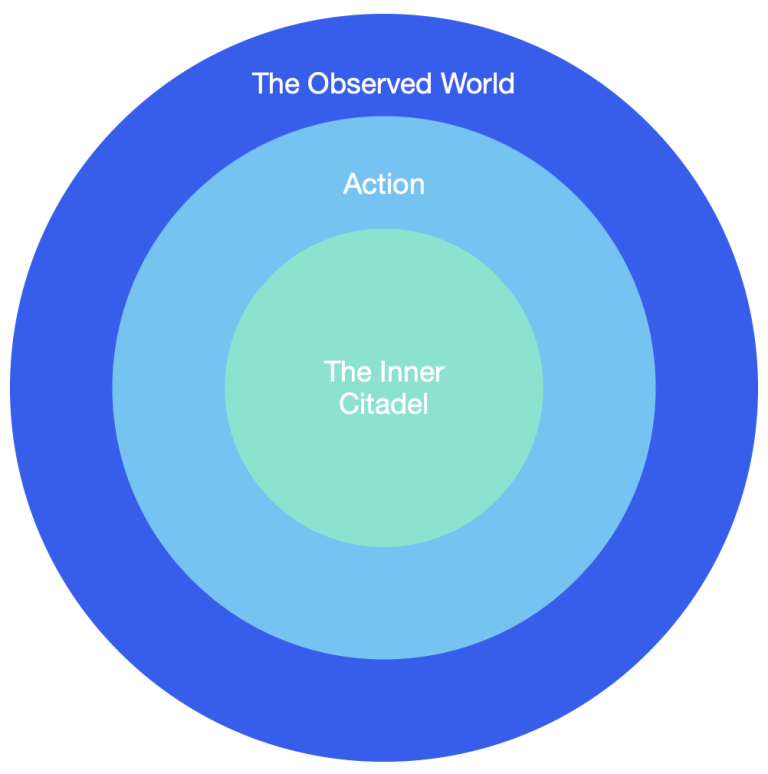
When first thinking about this, I realised that three concentric circles were the best way to describe the concept. And while there are only things we can control and things we can’t, there is also a middle domain, where those two things interact. That’s why the model has three circles.
We often see this idea described as “living in accordance with nature”, and that’s certainly how Zeno described it. But that can seem quite vague, and a little confusing to modern readers, who tend to think of “nature” as plants and bees and stuff. The original Stoics were really thinking about nature as the entirety of reality itself.
So let’s take a closer look at this structure, focusing on each domain from the inside outwards.
The Inner Citadel
So named by Epictetus, the Inner Citadel is the fortress of our conscious mind. This is the domain most fully under our control, but that control depends on coherent thinking.
This is the realm of judgement, attention, values, interpretation and conscious endorsement. It is where we decide what we believe, what we pursue, what we reject, what we permit into our reasoning, and what we refuse to let govern us.
As rational agents, values are goods we consciously recognise. I tend to think of them as those requirements that, when fulfilled, lead to a state of calm contentment. It’s not excitement, not pride nor ecstasy, but a sort of background sense that everything is right.
Our values emerge from our individual genetics and backgrounds. But they are things that we, as individuals, genuinely like and endorse consciously.
As such, there is usually no problem with the values we hold. The challenge is understanding them, prioritising them, and distinguishing them from urges we have never examined.
Urges are funny beasts. Of course most of us learn to control most of our base urges as we grow up, but that can leave us lowering our guard to some of them. And, even worse, some urges are positively encouraged by society at large.
Validation is one obvious example. There are times when a little might be just the ticket, but if no amount is ever enough then, well… you’re caught in a vicious trap.
Emotions are a very real and important part of the human experience. They well up from deep inside the oldest parts of our brains, and we share them with the beautiful animals we inhabit this world with. But they are not our masters, and we should never allow them to take that role. They can’t explain themselves, and they don’t understand reality like our conscious brains do. They are not conscious of their “goals” or values, and can’t reflect on strategies; letting them rule is a path to chaos and misery.
I indulge in my emotions, of course! I play video games, listen to music and share my life with Ellie. But I consciously endorse these things first. Coherence in your Inner Citadel depends on one decision maker calling the shots, and well… I’m afraid you’ve got the job.
Action
This is the circle where Stoicism becomes visible.
A coherent mind should produce coherent action: actions that are chosen deliberately, that fit with how the world actually works, and that remain under our control even when outcomes are not.
People often sabotage themselves here. They do not lack intelligence or good intentions; they simply act as though reality ought to bend to their wishes. When it doesn’t, they respond with frustration, resentment, or self-reproach.
If I want to knock down a wall, I should use a sledgehammer, not my head. That sounds obvious, almost childish, but it illustrates an important Stoic insight: wisdom is practical. Reality has constraints, and reason exists to cooperate with those constraints, not to rail against them. You know that meme “Old man yells at cloud”? Well, it works because people do this all the time.
I can choose my effort, my preparation, my honesty, and my persistence. I cannot choose whether those things will be rewarded, recognised, or even noticed.
A Stoic action is therefore one that can be fully endorsed at the moment it is taken, without borrowing justification from a hoped-for outcome. If the only reason I act is because I expect a particular result, then I have already handed control of my agency to chance.
This is why Stoicism places such emphasis on intention, effort, and character rather than success. Success is an external event; action is mine. We’re all playing poker, all the time.
When action is coherent, failure does not disintegrate the self. It merely provides information. When action is incoherent, even success corrodes us, because it rewards confusion rather than clarity.
To act Stoically is not to act timidly or passively. It is to act decisively, proportionately, and in full knowledge of what is and is not under our command.
The Observed World
The outer circle is the world beyond our command: other people, chance, the past, the weather, the economy, our bodies over time.
Stoicism does not ask us to pretend these things do not matter. It asks us to stop fighting them emotionally while continuing to understand them as clearly as possible.
This is the circle of acceptance, but not resignation.
Acceptance, in the Stoic sense, is the refusal to add a second layer of suffering on top of reality by insisting that it should have been otherwise. The past is fixed. Other people will choose as they choose. Fortune will distribute outcomes without regard for our preferences.
Resentment changes none of this. It merely distorts perception and drains energy from the domains where agency is still possible.
The proper stance toward the observed world is therefore one of dispassionate curiosity. We refine our mental models, correct our assumptions, and adjust our plans as reality reveals itself. We replace indignation with understanding, and fantasy with feedback.
When we accept the world as it is, we become better able to navigate it. When we refuse to accept it, we blind ourselves and then blame the darkness.
Stoicism’s final demand, then, is not that we like everything that happens, but that we stop demanding that reality conform to our expectations before we agree to live well within it.
Conclusion
So how do you like them apples?
I’m joking; it really doesn’t matter.
While you’re thinking about the ideas here, and while you’re forming questions and developing avenues of enquiry, the key things to remember are:
- The universe has laws.
- Humans can understand those laws and make decisions as rational agents.
- We live together in societies.
From these, everything else follows.
- As rational agents, we are compelled to make decisions. The Virtues are the tools we use to make them well.
- Wisdom allows us to read reality correctly so decisions are well-informed.
- Courage keeps our decisions free from the undue interference of fear.
- Temperance protects our decisions from untrammelled urges.
- Justice respects the rational agency of others.
- The dichotomy of control then tells us where those decisions apply.
- The Inner Citadel is the domain of judgement, value, attention and interpretation.
- Action is the domain of chosen effort in the world.
- The Observed World is everything beyond our command, which must be accepted, studied and understood.
That is Stoicism
It is not coldness. It is not passivity. It is not pretending that nothing matters. It is a philosophy of rational agency: a way of living in which we try to make the best decisions available to us, in the world as it actually is, without disintegrating the fabric that holds those decisions together.
That means the conscious, thinking self.
And it means a society of rational agents acting in a shared world.
I have striven to present Stoicism as simply as possible, bringing together the whole structure while omitting the extraneous details. I haven’t discussed how we can live Stoically in a non-Stoic world. Not yet. And that’s because, in order to do so, we’re going to need a little more time, and we’ll have to do a little more work.
Like I said right at the top of this page, Stoicism is pretty simple, but it is also counterintuitive. Understanding these concepts is one thing; living by them is another. But if you’re ready to start learning how to do so, then everything you need is here.
If you’re ready, come and join us at The Stoa.
Or dive deeper with The Foundations Series.
Either way, I’m delighted you’re here, and wish you every success in finding your Eudaimonia.
– Matt Shewbridge